
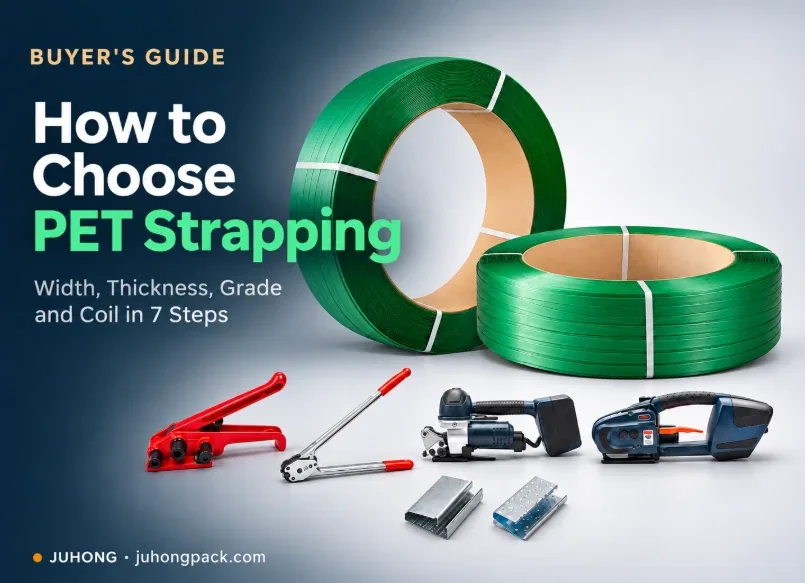
To choose PET strapping, start with the tool or machine that will apply it, because the tool sets the width. Then pick a thickness and quality grade that stay well above the pull of your tool, choose a smooth or embossed surface for your joint, match the coil and core to your dispenser or machine, and test the size on your own load before a volume order.
We have made PET strapping at our plant in Changzhou, Jiangsu since 2011. It runs on five production lines with about 12,000 tons of capacity a year, and we ship it to customers in more than 50 countries. When a buyer asks us which size to order, we work through the steps below in this order, with the numbers needed for a purchase specification: inch and millimeter sizes, how break strength follows from width, thickness and grade, the width windows of common PET strapping tools, and the coil formats we wind.
Key takeaways
- Your tool, seal or strapping machine sets the width first. A 13 to 16 mm battery tool cannot run 19 mm.
- Break strength equals width × thickness × the breaking tenacity of the grade. A 16 × 0.8 mm size breaks at about 5,000 N in grade M and 5,600 N in grade H, and our PET strapping size chart lists every size.
- Dividing pallet weight by the number of bands gives a rough start. The joint, the pull of your tool and transport shocks matter more.
- Set the tool to tension the band to about 50 to 70% of its break strength. A tool that pulls close to the break strength snaps bands, and a size much heavier than the load needs only adds cost.
- Machine grade PET strapping has tighter width and thickness tolerances than hand grade, so automatic heads feed and weld it without misfeeds.
- Contact us with the tool or machine model, the label of your current coil and the load details, and test samples on your own load before you order by the ton.
What to Know Before You Choose the Right PET Strap
Four facts decide the right PET strapping size, and most buyers already have them:
- The model number of your hand tool, battery tool, pneumatic tool or automatic strapping head. It fixes the width range, the thickness range and the maximum pull.
- The load: weight per pallet or bundle, whether it is rigid (bricks, ingots, glass) or settles (bagged goods, cartons, timber), and whether it has sharp edges.
- The route. A pallet that stays in a warehouse needs less than one that goes by truck, container and rail, because every handling on a long route puts another shock into each band.
- Your current coil, if you already buy PET. Its label usually shows width, thickness, break strength and core size. When a buyer sends us a photo of that label, we can match the size or suggest a better one.
Without these four, any size you choose is a guess.
PP vs PET vs Steel Strap: Choose the Right Strapping Material First
Before you size PET strapping, check that PET suits the load at all. The first question most buyers face is PP or PET. PP and PET strapping are the two common plastic strapping materials, and steel strapping covers the heaviest loads. These three types of strapping behave differently.
Polyester Strapping (PET)
Polyester strapping is made from polyethylene terephthalate (PET). It has high tensile strength and good tension retention. Under a shock it stretches and then recovers, so medium and heavy pallets and bundles stay tight when they settle in transit. It does not rust, stands up to UV and moisture, and is 100% recyclable, which matters to buyers with sustainability targets.

Polypropylene Strapping (PP Strap)
Polypropylene strapping is lighter and cheaper, but it stretches more and relaxes over time. It suits cartons, light boxes and small bundles that do not travel far. Strapping tape is something else: a reinforced adhesive tape for closing cartons. If your load is a light carton, PP is usually enough and you can stop here. If you are switching from PP to PET because bands snap or go slack, read on for the size to start with.
Steel Strap
Steel strapping, or metal strapping, is still the better choice for very heavy, hot or sharp-edged loads that would cut plastic banding. On bricks, timber, cotton bales and many metal loads, PET strapping is now used as an alternative to steel, and buyers using steel strapping today often test PET to cut weight and get rid of sharp cut ends. Compare PET with steel before you change. Our PP vs PET vs steel comparison sets out the differences between PET and PP, and how both compare with steel.

Step 1: Let Your Strapping Tool or Machine Set the PET Strapping Width
Every tensioner, sealer, friction-weld head and automatic machine is built for a width window. A band outside that window slips, jams or welds badly, however well it suits the load. So take the width from your tool first, and only then check that the strength in that width suits the load.
PET Strapping Tool Width and Thickness Windows
These are the width and pull ranges of the strapping equipment we supply with our PET:
| Tool type (models) | Width | Thickness | Max pull |
|---|---|---|---|
| Battery friction-weld tools (JD13 / JD16, JDC13 / JDC16) | 13-16 mm (1/2-5/8 in) | 0.4-1.2 mm | 2,800 N |
| Battery tools, heavy duty (JDS13 / JDS16) | 13-16 mm (1/2-5/8 in) | 0.4-1.2 mm | 3,200 N |
| Battery tools for PET (DD19A / DD25A) | 16-19 mm / 19-25 mm | 0.5-1.2 mm | 400-5,000 N |
| Pneumatic tools (A19 / A25) | 13-19 mm / 19-25 mm | 0.5-1.2 / 0.5-1.5 mm | 3,500 N |
| Pneumatic tool for wide PET (XQD-32A) | 32 mm (1‑1/4 in) | 1.0-1.5 mm | 6,500 N |
| Manual tensioner and sealer sets (H19 with J19 or C380) | 13-19 mm / 16-19 mm | 0.5-1.0 mm | Set by the operator |
The ranges come from the specifications of our battery, pneumatic and manual tools. An automatic strapping system lists its own width range in its manual.
If you use metal seals, the seal has to match the width too. A 16 mm seal will not hold a 19 mm band, so order the seals for PET in the same width.

PET Strapping Sizes in Inches and Millimeters
Many overseas buyers order PET strapping in fractional inches, while factories in China, ours included, quote in millimeters. One nominal inch size covers more than one metric width, so put the millimeter width on the order:
| Inch size | Metric widths that match | Common thicknesses |
|---|---|---|
| 3/8 in | 9 mm | 0.020-0.024 in (0.5-0.6 mm) |
| 1/2 in | 10, 11, 12 or 13 mm | 0.020-0.040 in (0.5-1.0 mm) |
| 5/8 in | 15 or 16 mm | 0.020-0.050 in (0.5-1.2 mm) |
| 3/4 in | 19 mm | 0.030-0.055 in (0.8-1.4 mm) |
| 1 in | 25 mm | 0.030-0.055 in (0.8-1.4 mm) |
| 1‑1/4 in | 32 mm (31.75 mm) | 0.030-0.055 in (0.8-1.4 mm) |
Thickness converts at 0.001 in = 0.0254 mm, so 0.020 in is 0.51 mm, 0.030 in is 0.76 mm, 0.040 in is 1.02 mm and 0.050 in is 1.27 mm. Our full PET strapping sizes and break strength chart lists every width from 9 to 32 mm with break strength in kg, lb and N.
Step 2: Choose Thickness and Grade for the Break Strength You Need
With the width fixed, thickness and quality grade set the break strength. A thicker band in the same width is stronger and stiffer, and a higher grade gets more strength out of the same width and thickness.
How PET Strapping Break Strength Is Calculated
The break strength of PET strapping is its cross-section multiplied by its breaking tenacity:
Break strength (N) = width (mm) × thickness (mm) × breaking tenacity (MPa)
Breaking tenacity is the tensile strength of the polyester itself, and the quality grade sets it. These are our grades and their minimum tenacity:
| Quality grade | Breaking tenacity |
|---|---|
| L | ≥ 343 MPa (35 kg/mm²) |
| M | ≥ 392 MPa (40 kg/mm²) |
| H | ≥ 441 MPa (45 kg/mm²) |
| S | ≥ 490 MPa (50 kg/mm²) |
The formula gives these minimum break strengths for common sizes:
| Size (width × thickness) | Cross-section | Grade M | Grade H |
|---|---|---|---|
| 12 × 0.6 mm (1/2 in) | 7.2 mm² | 2,822 N (635 lbf) | 3,175 N (714 lbf) |
| 16 × 0.8 mm (5/8 in) | 12.8 mm² | 5,018 N (1,128 lbf) | 5,645 N (1,269 lbf) |
| 19 × 1.0 mm (3/4 in) | 19.0 mm² | 7,448 N (1,674 lbf) | 8,379 N (1,884 lbf) |
| 25 × 1.2 mm (1 in) | 30.0 mm² | 11,760 N (2,644 lbf) | 13,230 N (2,974 lbf) |
We calculated these from the grade minimums above. The break strength for your size and grade is confirmed on the order and in the test report for your batch.
That is why two quotes for “16 mm PET” can be so far apart in price and performance. 16 × 0.6 mm in grade L and 16 × 1.0 mm in grade S share a width, yet the second breaks at more than twice the force of the first. Always state width, thickness and the minimum break strength you require.
Why Pallet Weight Divided by the Number of Bands Is Only a Rough Start
Many sizing guides divide the load weight by the number of bands, multiply by a safety factor and call the result the break strength you need. Use that number as a first filter only. A PET band on a pallet works differently from a lifting sling: it holds the load by the tension it keeps after sealing.
The forces that break it come from braking, forklift impacts and loads that shift or settle, and they depend more on how the load moves than on what it weighs. A 1,000 kg pallet of tightly packed steel parts and a 1,000 kg pallet of loose cartons need different strapping. Published safety factors also range from about 1.5 to 3 depending on the source and the route, which tells you how rough the method is.
Two checks matter more than the formula. First, the seal or weld is usually weaker than the band, so a strong band with a poor joint fails at the joint. Second, after tensioning the band has to sit well below its break strength, so it still has room to absorb shocks in transport.
Leave a Margin Above the Pull of Your Tool
Compare the maximum pull of your tool with the break strength of the size. Strapping supplier guides commonly recommend tensioning polyester strap to its working range, about 50 to 70% of its break strength. Above that, the band or the joint can break while it is tensioned or on the first bump in transport.
Take a battery tool that pulls up to 2,800 N. At full power on 12 × 0.6 mm in grade M (2,822 N), it runs at about 99% of the break strength and leaves no reserve; on that size it should be set to roughly 1,400 to 2,000 N. At full power on 16 × 0.8 mm in grade M (5,018 N), the same tool pulls about 56% of the break strength, inside the working range.
We have seen what happens when this goes wrong. One of our customers bought a very high-tension electric strapping tool and ran it on our PET strapping, and the bands kept breaking. There was nothing wrong with the bands; the tool was pulling close to their break strength. If you move to a stronger tool, turn its tension down to the working range or choose a size whose break strength sits well above the tool’s maximum pull.
PET strapping stretches and recovers, so it absorbs shock that steel strapping passes straight to the seal. It can only do that with a margin between the applied pull and the break strength. If the load needs a tighter hold, move up in thickness or grade rather than run a thin size at the tool’s limit. You can read more about how PET strapping holds a load through tension, elongation and recovery.
Do Not Over-Specify: A Brick Plant Example
Going too heavy costs money without holding the load any better. A brick plant that buys from us normally straps each load with three bands of 19 × 0.8 mm. One order went out as 25 × 1.2 mm by mistake. That size has about twice the cross-section (30 mm² against 15.2 mm²), so every meter weighs about twice as much and costs about twice as much, on loads that 19 × 0.8 mm already held.
Before you move up a size, check whether the current size actually fails. If it holds, setting the tool correctly usually does more for the load than a heavier strap.
Step 3: Choose Hand Grade for Hand Strapping or Machine Grade for Machines
We hold machine-grade PET strapping to a higher break strength and tighter width and thickness tolerances than hand grade. An automatic head feeds, tensions and welds without stopping, and small variations in width or thickness cause misfeeds or weak welds.
Hand grade suits manual strapping with tensioners and sealers, battery-powered strapping tools, pneumatic hand tools and lighter daily volumes. Machine grade is for semi-automatic and automatic strapping machines and arch machines on a production line.
Both come in the same widths and differ in tolerance, strength target and coil size. If a hand tool already runs your current coils well, you do not need machine grade. If an automatic line keeps stopping for misfeeds, check the width and thickness tolerance of the coil before you blame the machine.

Step 4: Smooth or Embossed? Match the Plastic Strap Surface to Your Joint
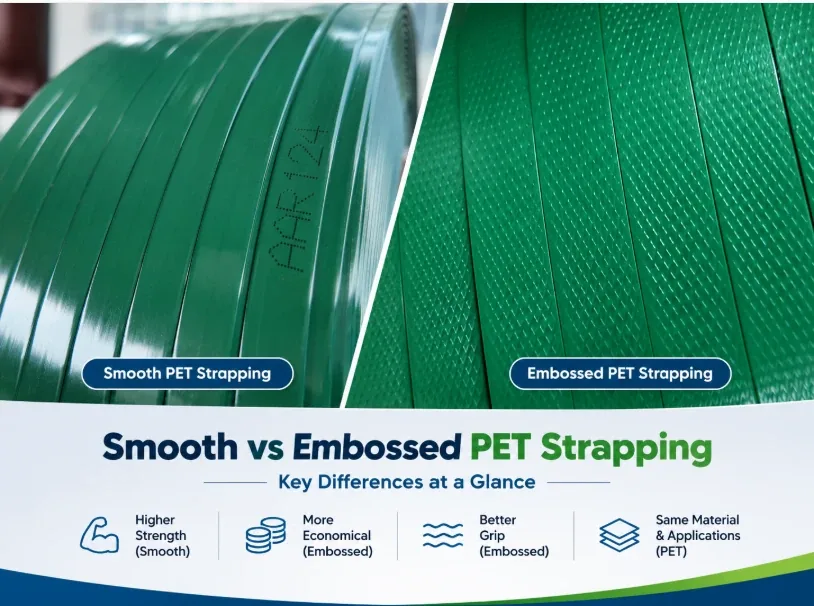
PET strapping comes smooth or embossed, and the right surface depends on how you join it. Embossed PET has a raised pattern that helps it grip inside metal seals and in some tools; in our orders, customers who join with metal seals choose embossed strap more often than smooth. Smooth PET is often used on friction-weld tools and automatic machines, which fuse the two layers together. Of the two, smooth PET strapping has the higher strength, and embossed PET strapping is the more economical choice.
There are three ways to join PET strapping: a metal seal crimped by a sealer, a friction weld made by a battery, pneumatic or automatic tool, or a heat seal made on an automatic machine. Friction welds and heat seals need no seals. Whichever joint your strapping process uses, it is the weakest point of the loop, so choose the surface your tool maker recommends and check the joints in your trial.
Step 5: Pick the Coil Weight and Core for Your Dispenser or Strapping System
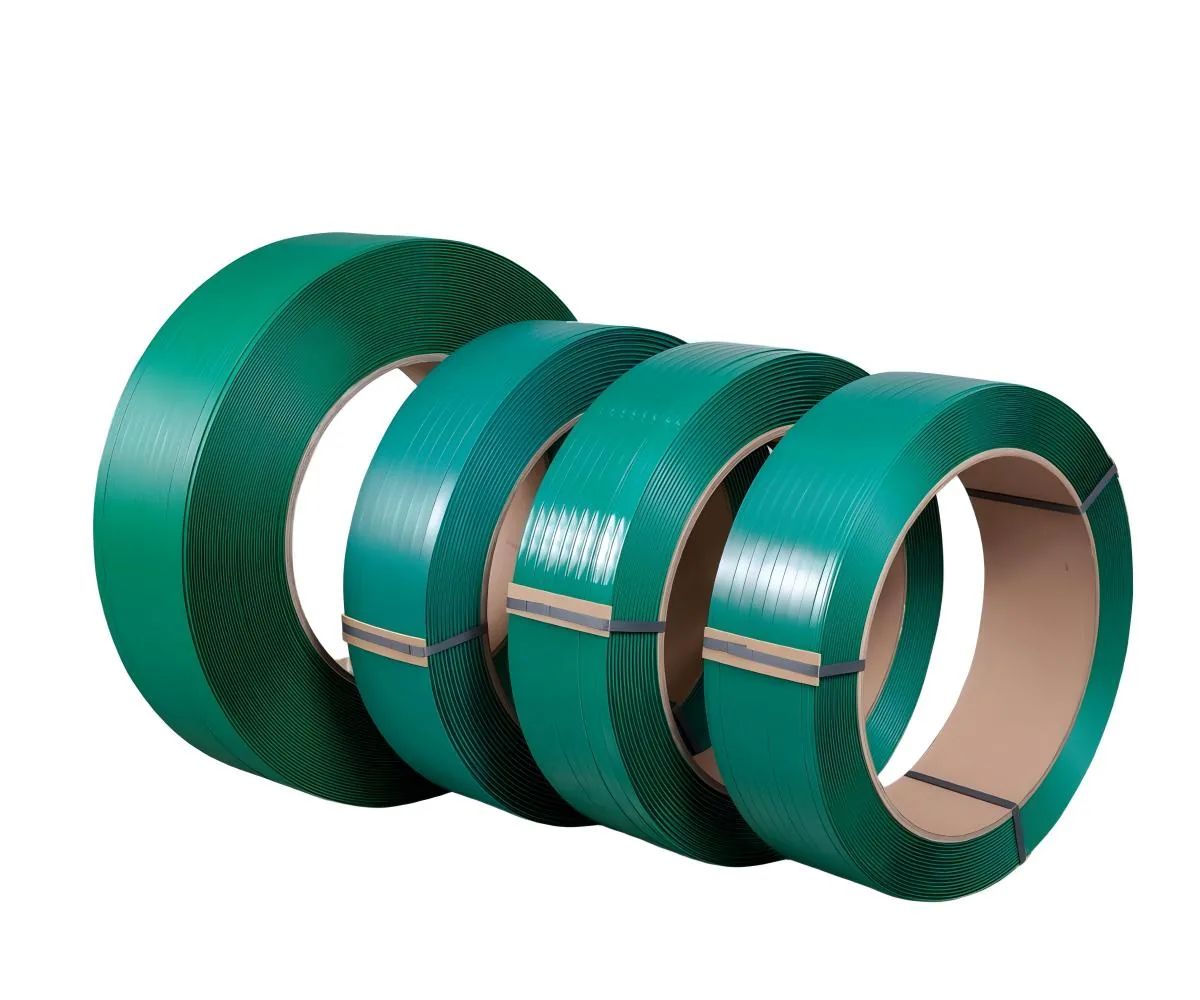
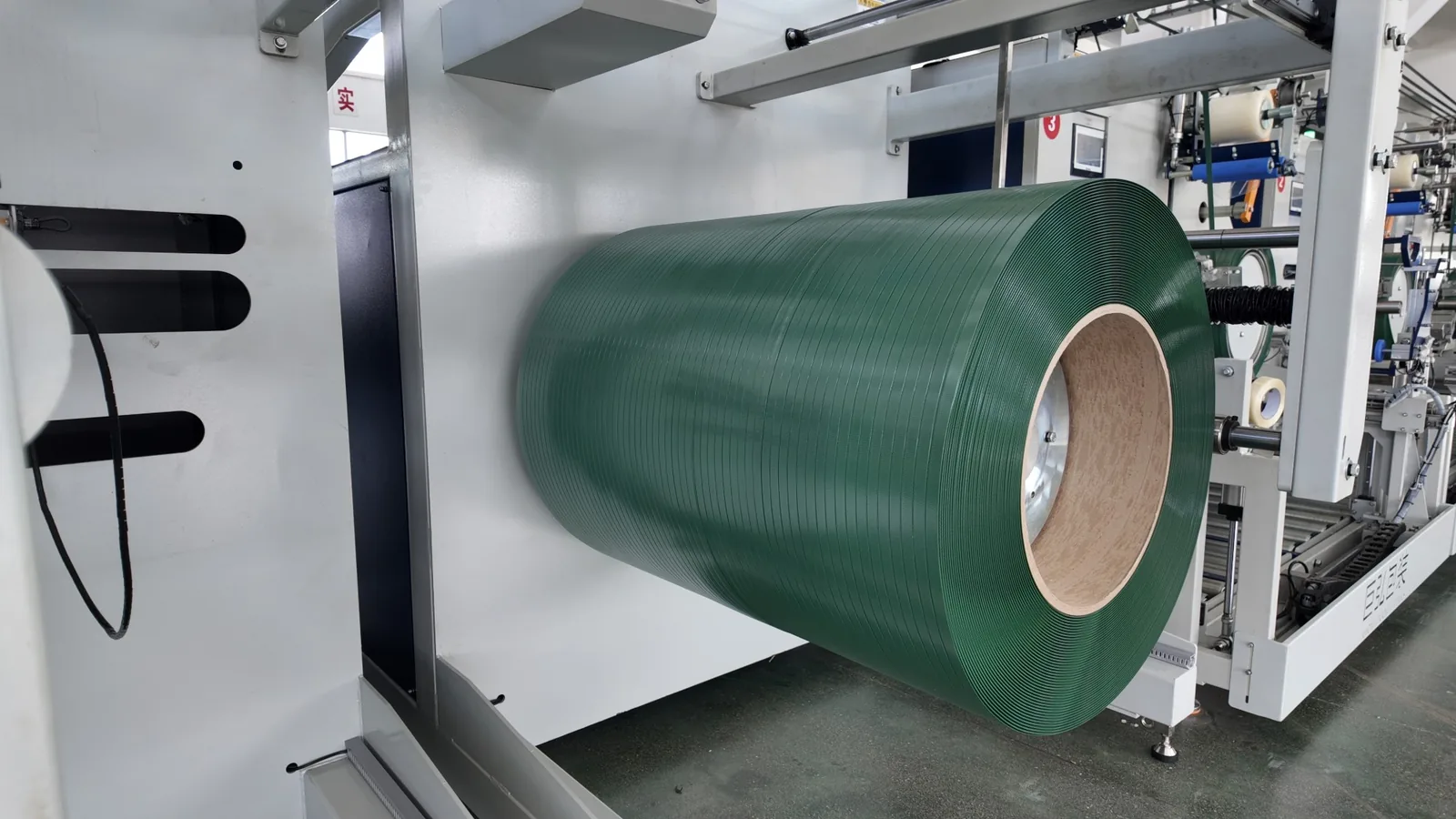
The coil has to fit your dispenser or machine before its strength matters. We wind all our PET strapping coils on a 406 mm (16 in) paper core, and the core width and coil weight change with the format:
| Coil format | Core (ID × width) | Typical use |
|---|---|---|
| 10 kg roll | 406 × 76 mm (16 × 3 in) | Manual and battery tools, light hand use |
| 20 kg roll | 406 × 150 mm (16 × 6 in) | Hand tools and many strapping machines |
| 70 kg coil | 406 × 190 mm (16 × 7.5 in) | Semi-automatic and automatic machines |
| 330 kg coil | 406 × 305 mm (16 × 12 in) | High-volume automatic lines |
| Up to 1,000 kg | Matched to the machine | Automatic lines that want the fewest coil changes |
Heavier coils mean fewer coil changes per shift, but they need a forklift and a matching coil holder. Send us the model of your dispenser or machine so the core width fits. Our PET strapping coil formats include pallet and container loads for each weight.
Step 6: Choose Color, Printing and AAR Markings
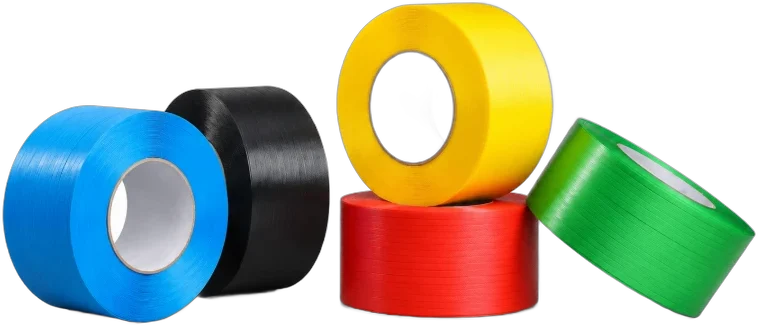
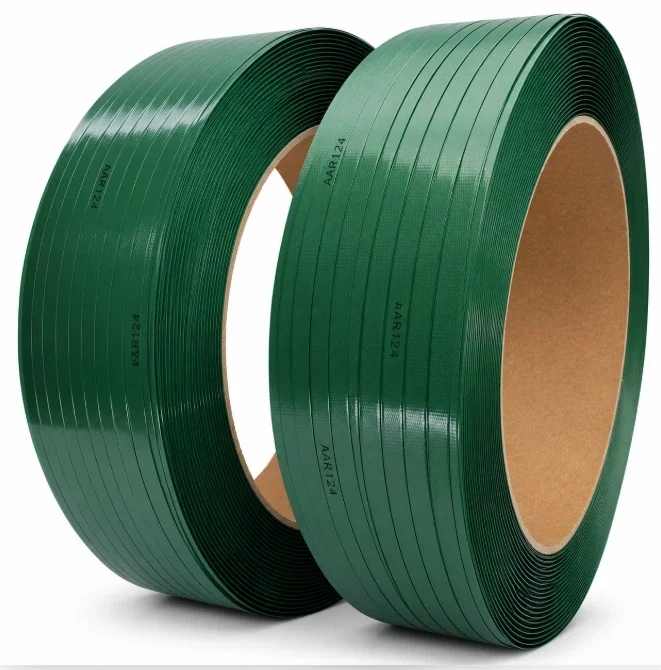
Color does not change the strength of PET strapping; it is there for identification. Green and black are the colors our customers order most, and we also make red, blue, white and yellow PET strapping. A separate color can mark a customer, a product line or a shift.
Printing puts information on the band itself. If the load travels on North American railroads and needs AAR-approved strapping, every AAR PET coil we supply is printed AAR124, so the marking can be checked on the load. Our AAR-approved strapping lists the sizes covered. We can also print your company name or a product code along the band; custom printing has its own minimum order, which we agree for each order.
Step 7: Test the PET Strapping Size on Your Own Load
A size that looks right on paper still needs a trial. Run samples on your own tool or machine and your own load before a volume order:
- Tension and seal a batch of bands at your normal tool settings and strap tension, and check that none break.
- Check each joint. Welds should be even with no thin or burnt spots, and seals should be fully crimped. Cut strap ends flush so nobody catches them.
- Ship or store a few loads the usual way and check them on arrival. A band that is slack after transit needs a tighter pull, a heavier size or more bands.
- Write the approved width, thickness, strap grade, surface and core into the purchase order, so every batch is checked against the same values.
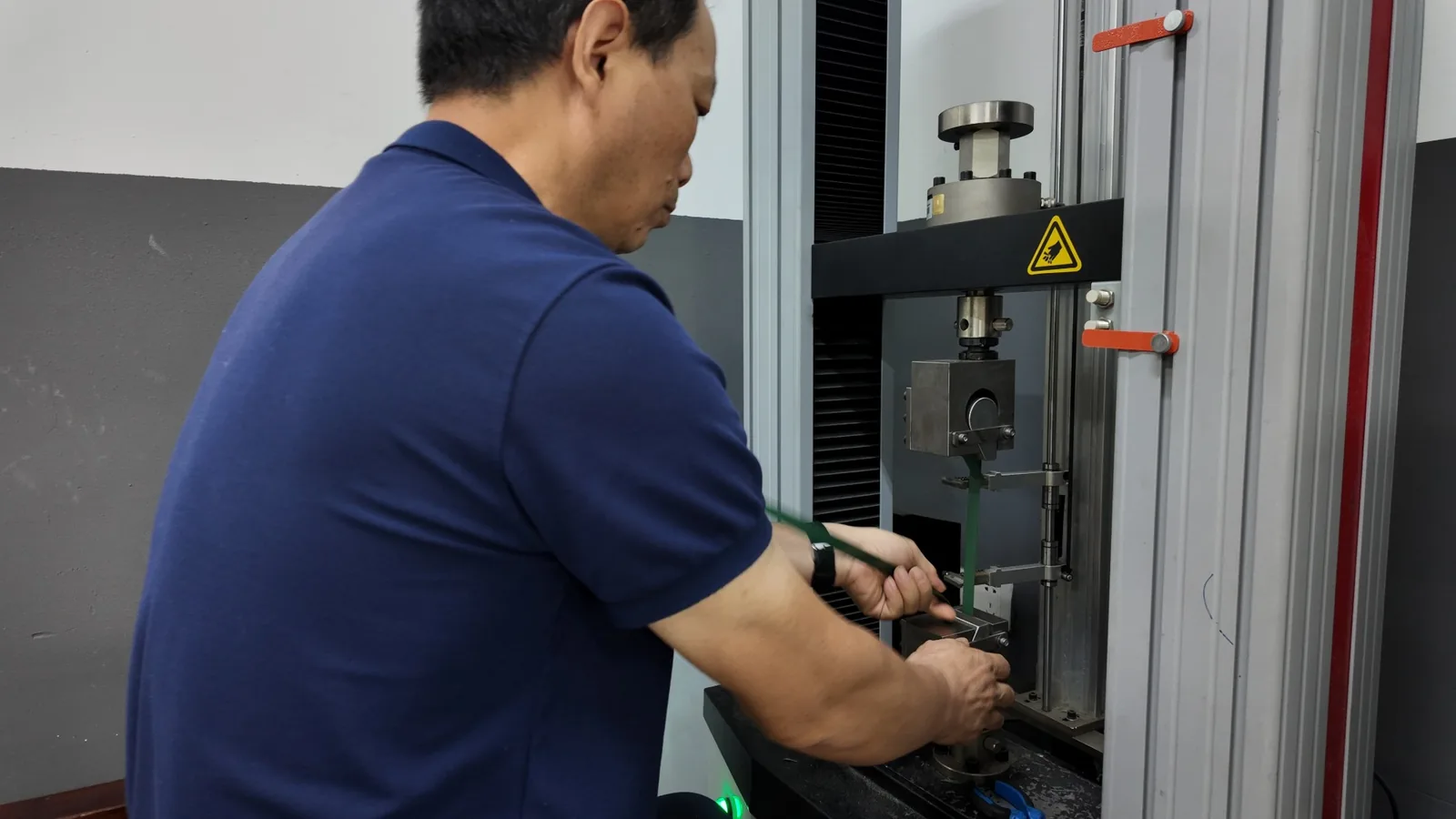
We send samples of standard PET strapping sizes free, and our minimum order for PET strapping is 1 ton. We test break strength and elongation in our own lab, and you can see how in our quality control process.
Packaging Strapping Specification Checklist for Your PET Quote
Use this list when you ask any supplier for a PET strapping quote. A quote without thickness or break strength cannot be compared with one that has them.
| Item | What to state |
|---|---|
| Width | Exact width in mm (and the inch size you use) |
| Thickness | Exact thickness in mm or inches |
| Break strength | Minimum break strength in N, kg or lb |
| Grade | Hand grade or machine grade, and the quality grade if known |
| Surface | Smooth or embossed |
| Color and printing | Color, AAR124 printing or custom print text |
| Coil | Coil weight, core inside diameter and core width |
| Tool or machine | Model of the tool, dispenser or strapping machine |
| Quantity and destination | Tons per order, port of destination and whether it shares a container with other products |
You can also download our PET strapping specification sheet (PDF) to compare sizes before you send the list.

Common Mistakes When Choosing PET Strapping Size
- Ordering by width alone. Without thickness and break strength, “5/8 in PET” can mean anything from about 2,000 N to 9,400 N.
- Choosing a size the tool cannot run. Anything wider or thicker than the tool’s window slips in the tensioner or welds badly.
- Running a thin size at full tool power. With no reserve for shocks, the band breaks while it is tensioned or in transit.
- Over-specifying the size. A band much heavier than the load needs, such as 25 × 1.2 mm where 19 × 0.8 mm holds, roughly doubles the strap cost and holds the load no better.
- Putting hand grade on an automatic machine. Its looser tolerances cause misfeeds and weak welds.
- Skipping the joint check. A strong band is wasted if the seal or weld fails first.
- Changing size without a trial. A thinner size may save money per ton and then cost more in broken bands and damaged loads.
- Buying the cheapest strap per roll. Compare the total cost of ownership: price per ton, meters per roll, bands that break and loads that arrive damaged.
- Treating PET vs PP as a price decision only. PP costs less per roll, but on heavy or export loads it relaxes and lets the load move, so judge each strapping option by the state of the load at the destination.
Frequently Asked Questions About Choosing PET Strapping
What is the price of a PET strap roll?
The price depends on width, thickness, grade, roll weight and the price of PET resin when you order. Price per ton is the fairest way to compare suppliers, because a thin size gives more meters per roll than a thick one at the same weight. Send us your size and quantity and we will quote per ton and per roll.
How strong is poly strapping?
“Poly strapping” covers both polyester (PET) and polypropylene (PP), and their strength differs. Our PET strapping ranges from about 1,540 N (346 lb) for 9 × 0.5 mm to about 21,950 N (4,938 lb) for 32 × 1.4 mm, depending on width, thickness and grade. PP strapping of the same size breaks at a lower force and loses tension faster, which is why heavy loads use PET.
What are the uses of PET straps?
PET strapping holds pallets and bundles of bricks and blocks, timber, cotton and fiber bales, paper rolls, glass, and metals such as ingots, coils and pipe. On many of these loads it has taken over from steel strapping. Our PET strapping applications show how each load is strapped.
Get a PET Strapping Size Recommendation
Send us the model of your tool or machine, a photo of your current coil label if you have one, and your load weight and route. We will suggest a width, thickness, grade and coil, and if you also need tools and seals, we can supply the whole strapping solution. We send samples for your trial. Contact us to start.
References
- ASTM D3950, Standard Specification for Strapping, Nonmetallic (and Joining Methods). ASTM International. https://store.astm.org/d3950-23.html
- PAC Strapping Products, Strapping Catalog (2018), Application Tips: Polyester Strapping (working range of 50 to 70% of break strength).